
Discover the Spiritual and Cultural Treasures of Switzerland Pilgrimage


Switzerland: A Journey of Faith and Heritage
Welcome to Switzerland Pilgrimage, a place to discover Switzerland through its rich religious, spiritual, and cultural heritage.
Switzerland is home to centuries-old churches, historic monasteries, secluded Alpine chapels, pilgrimage routes, sacred landscapes, and places connected with the many religious traditions that have shaped the country. Catholic pilgrimage sites form an important part of this heritage, alongside the history of the Reformation, Anabaptist and Mennonite communities, and Jewish life in Switzerland.
I created this website to share my knowledge and enthusiasm for this fascinating side of Switzerland. The articles offer a concise introduction to places, traditions, communities, and stories that have left their mark on the country. They are meant to provide inspiration, useful information, and a starting point for discovering destinations that may otherwise remain unknown to visitors.
Switzerland’s religious heritage can be found in many different settings: in medieval towns, quiet villages, remote mountain valleys, historic pilgrimage centres, and even along old paths crossing the Alps. Some places are well known, while others are modest and easily overlooked. Together, they reveal a side of Switzerland that goes far beyond its familiar image of mountains, lakes, and picturesque villages.
A website can only offer a glimpse into such a rich heritage. Many of these places become even more meaningful when their history is understood within its wider context and connected to the landscape around them. There are stories that cannot easily be captured in a short article, details that are easy to overlook, and places whose significance is best experienced in person.
For those who would like to go beyond the information presented here, I offer private guided tours throughout Switzerland. Whether you are planning a pilgrimage, exploring your family or religious heritage, or simply curious to discover a lesser-known side of the country, I can help you explore these places in greater depth and create a journey suited to your interests.
My aim is not simply to show you places, but to help you understand why they matter. Through history, architecture, local traditions, personal stories, and the landscapes in which they are found, each destination offers a different way of experiencing Switzerland.
Whether your interest lies in Catholic pilgrimage, Reformation history, Anabaptist and Mennonite heritage, Jewish history, sacred architecture, or the spiritual traditions of the Swiss Alps, I hope these pages will inspire you to look beyond Switzerland’s famous landscapes and discover the stories that lie within them.
This is a Switzerland shaped not only by mountains, lakes, and villages, but also by faith, history, memory, and centuries of religious heritage.
Living Traditions of Switzerland
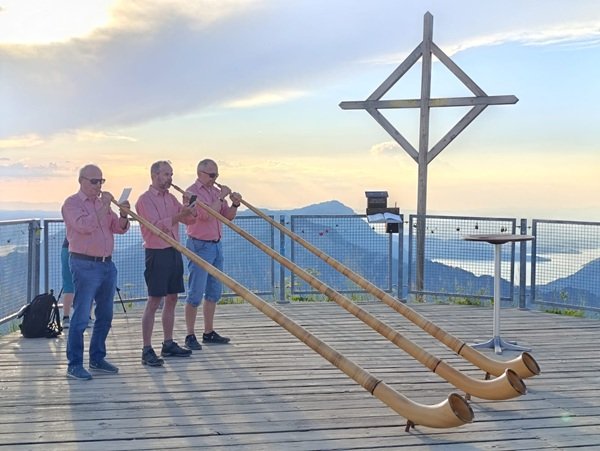
Switzerland is not only a country to visit, but a country to taste, hear and experience through its living traditions. Across the seasons, towns, villages and Alpine communities continue to celebrate customs that bring together faith, craftsmanship, food and local heritage.
From the spectacular St. Niklaus celebrations in Küssnacht, with bells, lanterns and traditional figures, to Alpine folklore festivals of music, costumes and dance, these traditions reveal a Switzerland deeply shaped by its communities and history.
Food is part of this story too. Chocolate and cheese are not simply Swiss specialties; they are connected to centuries of monastic and regional tradition. Religious communities played an important role in developing food production and recipes, including the early history of chocolate in Switzerland. In the world of cheese, the famous Tête de Moine, traditionally produced by the monks of Bellelay Abbey, is a remarkable example of how monastic heritage continues to live on at the table.
The calendar brings further traditions: Easter celebrations, cheese festivals, Christmas markets, and local beer traditions that bring people together around regional production and conviviality.
These experiences may not be pilgrimages themselves, but they belong naturally to the same journey. They allow travellers to discover Switzerland through its sacred heritage, its food, its celebrations and the people who continue to keep these traditions alive.
Mountains and Pilgrimage

Switzerland’s pilgrimage tradition is deeply connected to its mountains, but also to the cities, villages and valleys at their feet. For centuries, people have travelled from the plains towards Alpine chapels, shrines, monasteries and sanctuaries. The journey itself — through towns, countryside and mountains — became part of their expression of faith.
This connection has deep roots in Scripture. Mountains are mentioned hundreds of times in the Bible, and some of the most important encounters with God take place there: Moses receives the Law on Mount Sinai, Elijah encounters God on Mount Carmel, and Jesus repeatedly goes up the mountain to pray. On the mountain of the Transfiguration, the disciples glimpse His glory.
In the Bible, the mountain is therefore more than a place in the landscape. It is a place of encounter, revelation, prayer and transformation.
But the mountain is never the end of the story. Moses comes down from Sinai. Jesus comes down from the mountain to continue His journey among the people.
This same movement can be found in Swiss pilgrimage: from the city to the valley, from the valley to the mountain, and from the mountain back to everyday life. The sacred places of Switzerland are connected by this movement of people, faith and tradition.
“I lift up my eyes to the mountains: from where will my help come?”
Psalm 121:1
In Switzerland, the mountain is not simply a destination. It is part of a living pilgrimage — connecting the places where we live with the places where we seek God.
Beyond the ordinary. Discover the soul of Switzerland.

The Cammino Mariano Way was created to revive a Ticino tradition by retracing the steps of our grandparents. Over the […]

The Original Marian Pilgrimage in Ticino with All Four Majors Marian Shrines
Essentials
Four faith traditions. One country. One journey of discovery.
✝️ Catholic — Einsiedeln: Visit Einsiedeln Abbey and the shrine of the Black Madonna, Switzerland’s great Marian pilgrimage destination.
✝️ Protestant — Zürich: Discover Zürich’s Reformation heritage and the churches associated with Huldrych Zwingli.
☦️ Orthodox — Geneva: Visit Geneva’s Russian Orthodox Church and experience the city’s historic Orthodox presence.
✡️ Jewish — Endingen: Explore Endingen, one of Switzerland’s historic Jewish villages, with its remarkable synagogue and Jewish heritage.
Major Catholic Sites
✝️ Einsiedeln Abbey — Switzerland’s foremost Marian pilgrimage destination and home of the Black Madonna.
✝️ Mariastein Abbey — an important Marian pilgrimage sanctuary near Basel.
✝️ Flüeli-Ranft & Sachseln — the spiritual home of St. Nicholas of Flüe, Switzerland’s patron saint.
✝️ Saint-Maurice Abbey — one of Switzerland’s oldest Christian monasteries, with a remarkable history dating back to the early 6th century.
✝️ Abbey of St. Gall — a major center of Swiss Catholic and monastic heritage, renowned for its cathedral and historic library.
✝️ Madonna del Sasso, Locarno — a spectacular Marian sanctuary overlooking Lake Maggiore.
✝️ Jesuit Church, Lucerne — Switzerland’s first large Baroque church and one of Lucerne’s most beautiful Catholic landmarks.
✝️ St. Verena, Bad Zurzach — a historic pilgrimage site associated with St. Verena, one of Switzerland’s early Christian saints.
✝️ Hauterive Abbey — a historic Cistercian monastery near Fribourg, still home to a monastic community.
✝️ Notre-Dame des Marches, Broc — a beloved Marian pilgrimage sanctuary in the canton of Fribourg.
Major Reformation Sites
✝️ Zürich — Grossmünster: Zwingli and the birthplace of the Swiss Reformation.
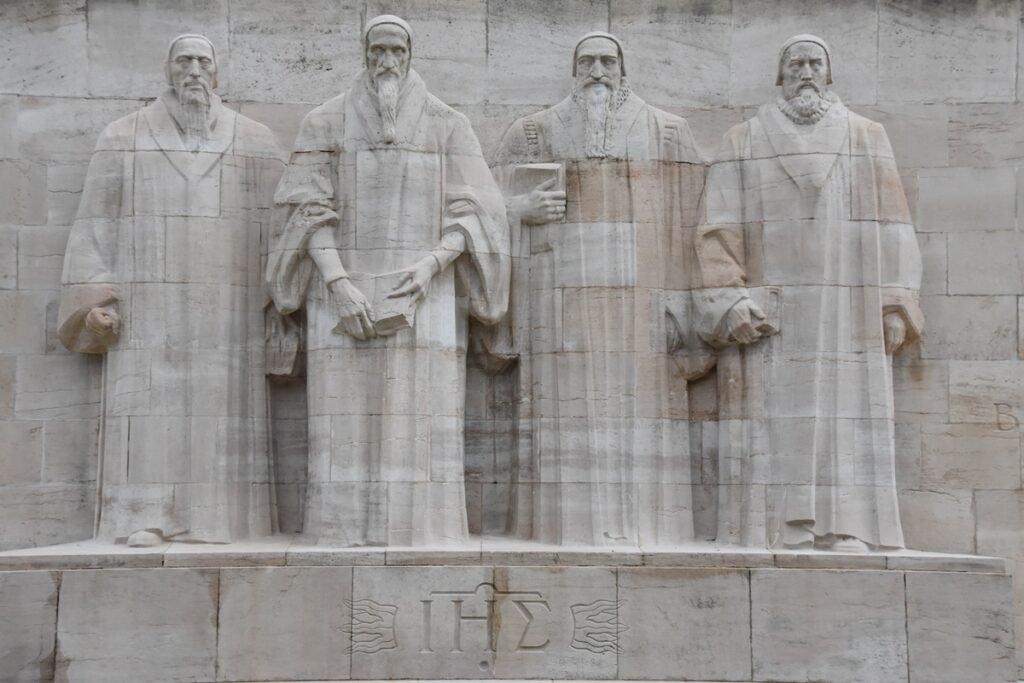
✝️ Geneva — St. Pierre Cathedral: Calvin and the Genevan Reformation.
✝️ Bern — Bern Minster: the great Gothic church and an important Reformation landmark.
✝️ Basel — Basel Minster: a major historic church at the center of Basel’s Reformation history.
✝️ Lausanne — Lausanne Cathedral: one of Switzerland’s great Gothic churches and an important center of the Reformation in French-speaking Switzerland.
✝️ Neuchâtel — Collégiale: associated with Guillaume Farel and the introduction of the Reformation.
✝️ Schaffhausen — St. Johann: the principal historic Reformed church of Schaffhausen and an important local Reformation site.
Anabaptist/Amish/Mennonite
Anabaptist / Mennonite
Zollikon (near Zürich) — the birthplace of the Swiss Anabaptist movement in 1525, where the first believers’ baptisms took place.
- Trachselwald — Trachselwald Castle – a site associated with the persecution of Anabaptists.
- Sumiswald — Sumiswald Castle – associated with Hans Haslibacher, the last Anabaptist martyr executed in Switzerland during 1571.
Thun — Thun Castle — important site of persecution; Anabaptists were imprisoned in the castle’s tower.
Emmental — Langnau — one of the historic heartlands of Swiss Anabaptism, with surviving Mennonite heritage.
Bernese Jura — Täuferweg / Anabaptist Trail — perhaps the best landscape-based pilgrimage experience, following the history of Anabaptist refugees and communities. The route includes the Pont des Anabaptistes near Corgémont.
Corgémont — Anabaptist Heritage Foundation — a particularly good stop for understanding the history, documents, and material heritage of Swiss Anabaptism.
Amish connection
Erlenbach, Bernese Oberland — birthplace of Jakob Ammann (1644–1730), whose followers became known as the Amish.
Oberhofen am Thunersee — where Ammann lived and worked before the Amish-Mennonite division.
Thun & surrounding Bernese Oberland — important ancestral territory for many Amish and Mennonite families who later emigrated to North America
Alpine Churches and Chapels
- Ziteil – Switzerland’s highest pilgrimage church and an important Marian pilgrimage site
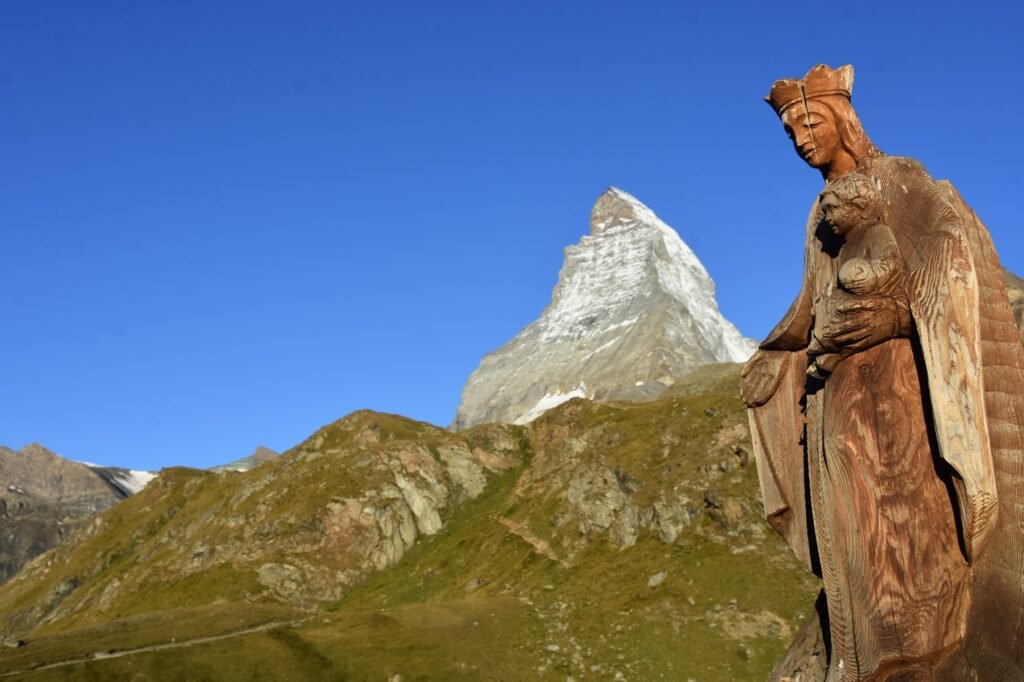
Schwarzsee – Maria zum Schnee, Zermatt
Riffelberg – Bruder Klaus, Zermatt
Maria zum Schnee, Bettmeralp
Rigi Klösterli – Maria zum Schnee
Fruttkapelle, Melchsee-Frutt
San Giovanni Battista, Mogno
Caplutta Sogn Benedetg
Maria Hilf, Stoos
Wildkirchli – St. Michael
St. Christopher Chapel, Grimsel Pass
Religious Routes
Religious Pilgrimage Routes in Switzerland
| Pilgrimage Route | Swiss Route / Region | Religious Significance |
|---|---|---|
| ✝️ Via Jacobi – Way of St. James | Rorschach – Einsiedeln – Lucerne – Fribourg – Lausanne – Geneva | Pilgrimage route to Santiago de Compostela |
| ✝️ Via Francigena | Sainte-Croix – Lausanne – Vevey – Saint-Maurice – Martigny – Great St. Bernard Pass | Historic pilgrimage route to Rome |
| ✝️ Via Francisca | Constance – St. Gallen – Chur – Disentis – Lukmanier Pass – Bellinzona – Ponte Tresa | Historic pilgrimage route toward Rome |
| ✝️ Via Columbani / Columban Way | Eastern Switzerland – Lake Constance – St. Gallen | Follows the footsteps of St. Columbanus |
| ✝️ Meinradweg / St. Meinrad Way | Central Switzerland – Einsiedeln | Pilgrimage route associated with St. Meinrad and Einsiedeln Abbey |
| ✝️ Bruder Klaus Way (Bruder-Klaus-Weg) | Central Switzerland – Sachseln – Flüeli-Ranft | Dedicated to St. Nicholas of Flüe (Brother Klaus), patron saint of Switzerland |
| ✝️ Cammino Mariano del Ticino | Ticino | Marian pilgrimage route linking the shrines and sanctuaries of Ticino |
| 🕊️ Anabaptist Trail (Täuferweg) | Emmental – Bernese Oberland – Bernese Jura | Follows the history and spiritual heritage of the Swiss Anabaptists |
| ✝️ Felix and Regula Pilgrimage Way | Eastern Switzerland – Zürich |
Religious Architecture
This stage is a beautiful walk through the woods of Monte Ceneri and across the Magadino plain. I really like it because those who, like me, have walked the Camino de Santiago will experience the same emotion as on Monte Gozo when they see the spires of St James’ Cathedral. Just above Quartino, on the way down, you can see the Sanctuary of the Madonna del Sasso in Orselina, the final destination of this pilgrimage. Visit the church of San Nicola di Bari in Quartino with a beautiful statue of St. Michael the Archangel, a replica of the one found in Monte Sant’Angelo in Puglia, where the archangel appeared.
Jewish Heritage
Key Jewish Heritage Sites
- ✡️ Bern — Jewish presence in the wider Bern region dates back to the 6th century; a documented Jewish community in Bern dates from 1259.
✡️ Endingen — historic Jewish village with its 19th-century synagogue and Jewish Cultural Trail.
✡️ Lengnau — the second historic Jewish village of the Surbtal, with its synagogue and Jewish heritage buildings.
✡️ Jewish Cemetery of Endingen–Lengnau — established in 1750, with around 2,700 graves; it is recognized as a cultural heritage site of national importance.
✡️ Zürich — an important center of modern Swiss Jewish life and home to several historic synagogues and Jewish institutions.
✡️ Basel — home to the Jewish Museum of Switzerland, opened in 1966 and documenting Jewish religious and cultural life in Switzerland.
✡️ Geneva — an important center of Jewish life in French-speaking Switzerland, with historic and contemporary Jewish institutions.
✡️ Baden — historically connected with the Jewish communities of the Surbtal and the development of Jewish life after emancipation.
Accomodation
Food
Transport
Before You Travel
Blogs


Lets have Tour Booking Enquiry

